OUR BLOG
Practical guidance, interview prompts, and preservation tips—built for families and legacy projects.
The Interview You’ll Regret Most Is the One You “Meant to Do Someday”
The Interview You’ll Regret Most Is the One You “Meant to Do Someday”

The moment arrives once. Being ready is a choice.
There’s a particular kind of silence that shows up when you say, “I’m going to record this.”
It’s not hostile. It’s not dramatic. It’s just… a subtle shift. The room tightens. The narrator becomes careful. The story gets shorter.
And later, you’re left with a recording that technically exists—but somehow missed the best parts: the ease, the honesty, the detail that makes a story feel like a living thing.
If you’ve ever thought, “I should interview them while I still can,” you already understand the stakes.
What most people don’t realize is this: interviews don’t fail because you didn’t have the perfect questions. They fail because you didn’t have a repeatable system—the kind that protects trust, prevents chaos, and actually gets finished.
“Winging it” is expensive (in the ways that matter)
Improvisation feels friendly. But when it comes to preserving a life story, it tends to charge you interest.
You pay in wasted time (the interview warms up right when it ends).
You pay in lost quality (audio you can’t stand to listen to).
You pay in relationship risk (because boundaries weren’t clear at the start).
And you pay in unfinished work (a file named “New Recording 53” that nobody ever hears).
This is the heart of a money-first choice: do you want to spend your time patching holes later—or use a proven workflow that prevents the holes in the first place?

Regret rarely comes from what you recorded—more often from what you missed.
The conversion truth: People don’t buy “tips.” They buy confidence.
When someone buys the OHP Starter Kit, they’re not buying information they couldn’t Google.
They’re buying relief from the three anxieties that stop interviews from happening:
“I’m not sure what I’m doing.”
“I don’t want to make this weird or intrusive.”
“Even if I record it, will it become something usable?”
This blog won’t teach you a step-by-step method (because that’s not the point). The point is to help you recognize why a kit exists at all: to make a high-stakes moment predictable instead of fragile.
So here’s the reality of what “done right” tends to require—without turning your life into homework.
First, you need clarity—because vague goals produce vague stories
The biggest invisible failure is starting with: “Tell me about your life.”
That’s not a question; it’s a fog machine.
Strong interviews happen when the interviewer has made a simple decision: what are we capturing, and why?
That’s exactly where the Project Planning & Scoping Workbook earns its keep. It’s not glamorous. It’s profitable—because clarity prevents rambling sessions and unusable recordings.
And if you’ve ever walked into an interview thinking, “I hope this goes well,” you already know why the The Interview Success Planner matters: it turns hope into preparedness, without you having to reinvent a process every time.
Then, you protect trust—because trust is the real recording device
Most people think consent is a formality. In family interviews, it’s often the difference between a guarded performance and an honest conversation.
Not because families are suspicious—because families are complicated.
The OHP approach is simple: protect dignity first, and you’ll get better stories as a byproduct.
That’s why the Customizable Informed Consent Form is not “admin.” It is the moment you communicate, in a concrete way: you’re safe here; you’re in control; you won’t be surprised later.
Money-first translation: consent protects your relationship and your final deliverable.

Trust doesn’t slow the interview down—it unlocks it.
Next, you need a steady flow—because good interviews are built on calm structure
A great interviewer doesn’t look like they’re “following a script.” They look present. Curious. Unrushed.
Ironically, that presence is often made possible by structure working quietly in the background.
That’s the purpose of The Essential Interview Checklist: it supports the invisible choreography—before, during, and after—so you’re not mentally juggling ten details while trying to listen like a human being.
Money-first translation: a checklist reduces rework, missed steps, and “I can’t believe I forgot to ask that” regret.

Structure is what allows you to be fully present.
Audio matters—because nobody re-listens to a recording that feels like work
People don’t abandon family recordings because they don’t care.
They abandon them because the audio is thin, noisy, echoey, or inconsistent—and listening feels like a chore.
That’s why the Guide to Affordable & Effective Recording Equipment is a conversion lever, not a nerd accessory: it helps people choose a setup that matches reality, budget, and environment—so the recording becomes listenable.
Money-first translation: usable audio increases the likelihood the story actually gets shared.

If it’s easy to listen to, it’s easy to keep.
The “after” is where most projects die—unless you have a preservation workflow
Here’s the part nobody warns you about: the interview isn’t finished when you stop recording.
Without a simple post-interview practice, the meaning leaks out fast—tone, themes, implications, the “why this mattered.”
That’s why The Storykeeper’s Log is so valuable. It protects the human layer that audio alone doesn’t capture.
And when you’re ready to turn a recording into something shareable, the Oral History Transcription Template moves you toward a professional outcome without you needing to guess formatting or standards.
Money-first translation: this is how an interview becomes a keepsake, not a file.

A story you can’t find—or use—eventually becomes a story you lose.
Mid-page CTA (conversion-focused, no content-dump)
If you want to stop improvising and start producing interviews that are ethical, listenable, and usable—
The OHP Starter Kit is the simplest way to get the workflow right without spending weeks assembling your own templates and second-guessing your decisions.
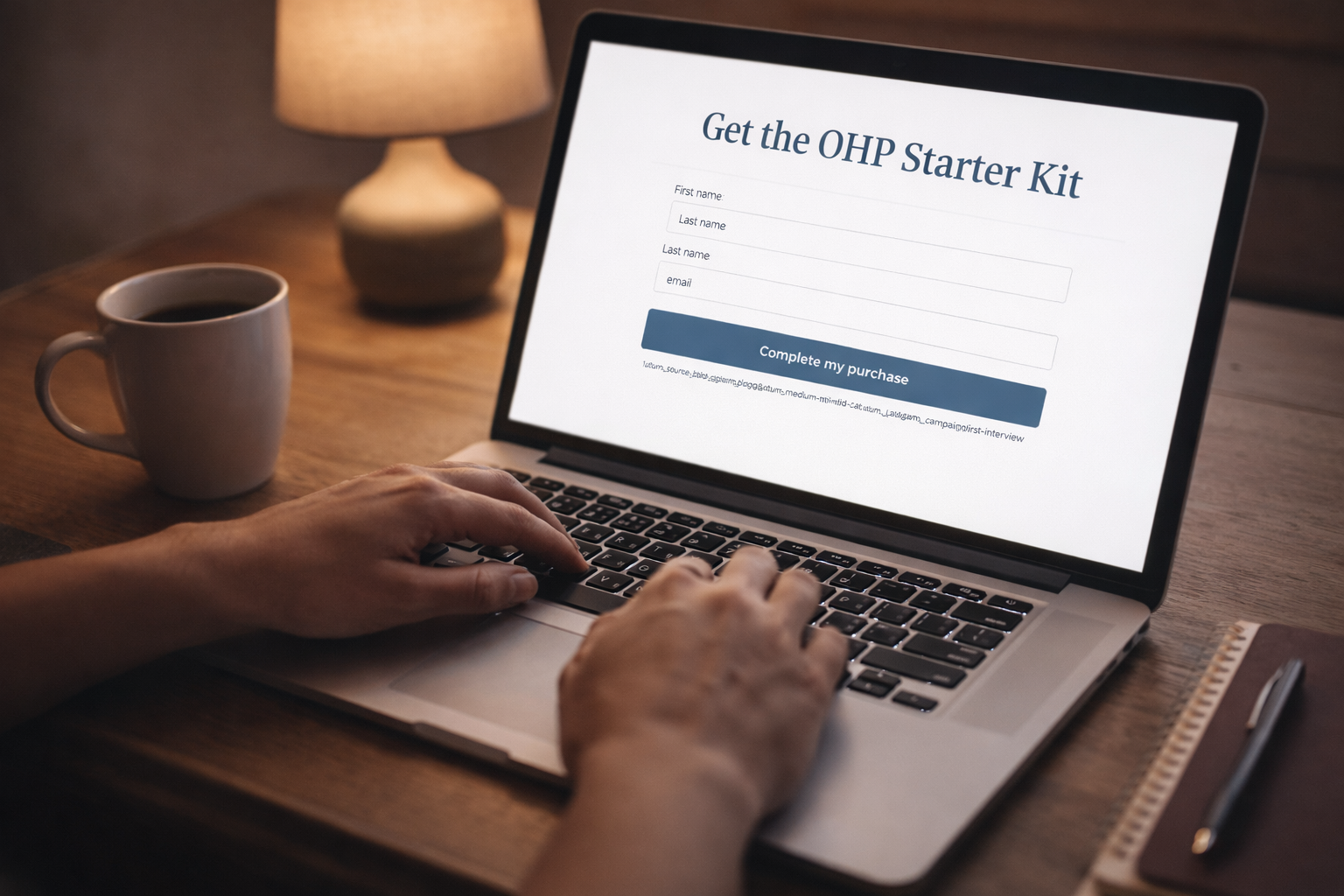
Make the next step feel obvious—and easy.
Bottom line: This is a moment worth doing properly
Family stories are one of the few assets that increase in value over time—emotionally, historically, and relationally.
And yet, most people treat the interview like a casual experiment.
Money-first means you don’t gamble with high-value moments.
It means you buy the process that:
creates clarity before the interview (Project Planning & Scoping)
protects trust upfront (Customizable Informed Consent)
keeps the session steady (Essential Interview Checklist)
makes audio listenable (Recording Equipment Guide)
and preserves meaning afterward (Storykeeper’s Log + Oral History Transcription Template)
Not as a list. As a workflow that shows up exactly when you need it.
Bottom CTA block (high motivation, high conversion)
IF you’ve been thinking “I need to record these stories,”
THEN don’t wait for a perfect day or a perfect plan.
Use the OHP Starter Kit to walk into the conversation with clarity, protect trust, and preserve what matters—so the recording becomes something your family will actually keep.

The best time to record a story is before it becomes a memory you can’t revisit.

Start Preserving Your Stories Today
Invest in the Oral History Starter Kit—prompts, planning tools, and a simple step-by-step process to help you record meaningful stories with confidence.
A guided toolkit that helps you plan, record, and preserve an interview—without the overwhelm.
Ask better questions with prompts that invite real stories
Stay organized with a simple session plan (prep → record → follow-up)
Capture clean audio/video with practical setup guidance
Handle sensitive moments with respectful consent and comfort tips
Preserve it properly so files stay accessible for the long haul
What's Included
This digital toolkit, developed from years of professional practice, provides the essential tools and templates to start your oral history project today:
Project Planning & Scoping Workbook: Define your goals and create a clear roadmap.
Customizable Informed Consent Form: The essential ethical document for any project.
The Essential Interview Checklist: A step-by-step guide for before, during, and after your interview.
Guide to Affordable & Effective Recording Equipment: Our top picks for any budget.
Oral History Transcription Template: A professional template to accurately transcribe interviews.
PLUS: Bonus Documents & Community Support (A $125+ Value!)
Here is 🎁 The Interviewer's Success Pack: Your free bonus guides (a $125 value). These added resources ensure you are fully prepared for every interview and have ongoing access to support.
The Interview Success Planner: Essential pre-interview worksheet for background research and preparation.
The Storykeeper's Log: Critical post-interview field notes template to capture immediate insights.
Private Facebook Group Invitation: Connect with fellow practitioners for tips, advice, and support.
Included free with your Starter Kit purchase.
If you want a simple, ethical way to capture meaningful stories—start here.
What you get: A complete digital Starter Kit—prompts, planning workbook, session checklist, consent form, and recording/transcription templates.
Timeframe: Start planning today and record your first interview this week.
Who it’s for: Anyone who wants to preserve meaningful family stories with a simple, ethical process—no experience required.
No experience needed • Ethical consent template included • Step-by-step guidance
One-time purchase. Instant access.
Site Menu
© 2025 The Oral History Practice, LLC. All rights reserved.
Instagram
Youtube
Facebook