OUR BLOG
Practical guidance, interview prompts, and preservation tips—built for families and legacy projects.
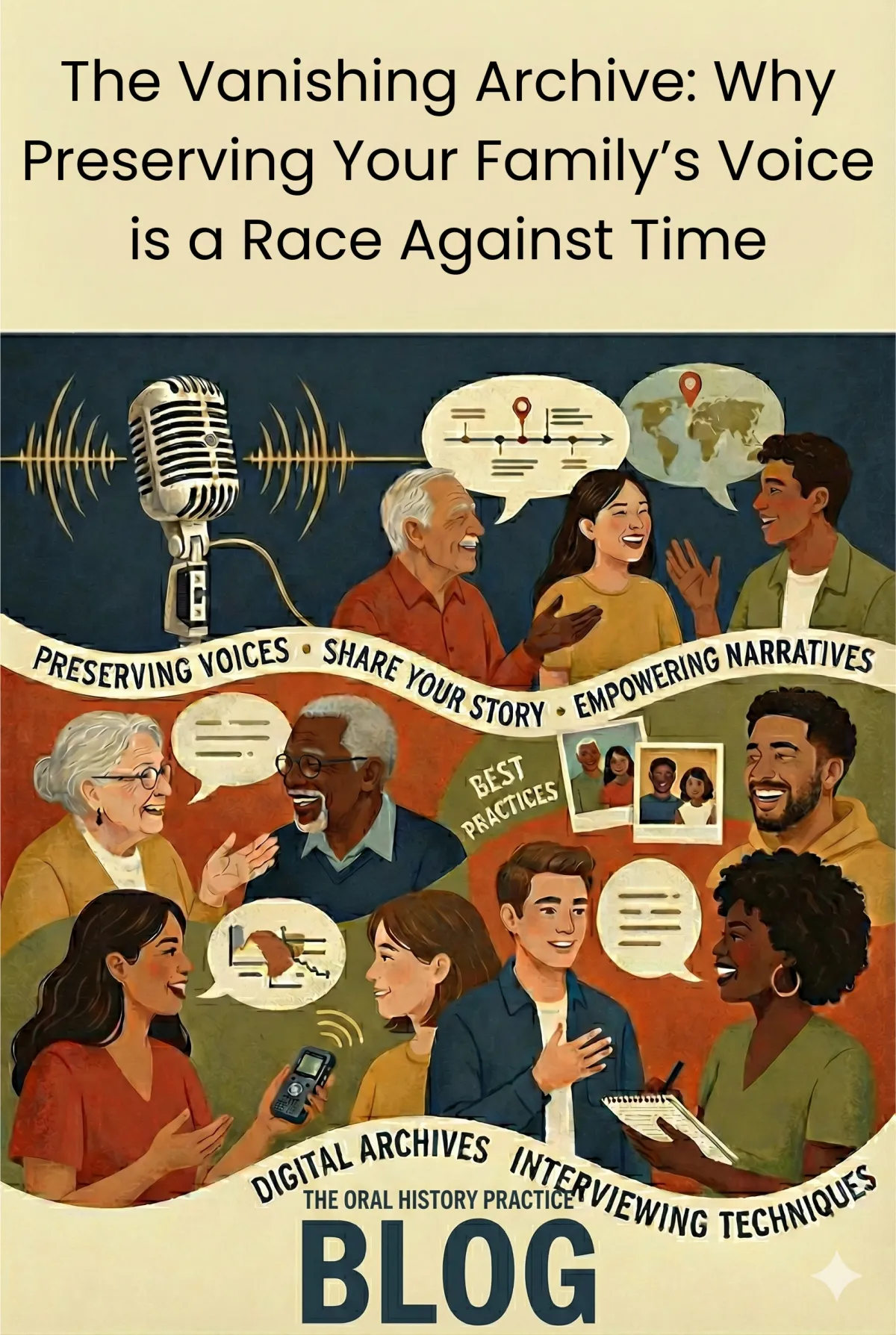
The Vanishing Archive: Why Preserving Your Family’s Voice is a Race Against Time
The Vanishing Archive: Why Preserving Your Family’s Voice is a Race Against Time
We tell ourselves a comforting lie about the people we love: that we will remember everything.
We believe that the specific timbre of our father’s voice, the cadence of our grandmother’s storytelling, or the exact way our aunt laughed when she was truly tickled will remain etched in our minds forever.
But memory is not a granite monument; it is a sandcastle at low tide. Life gets busy, seasons change, and slowly, the rich, detailed tapestry of our family's shared past begins to fray. We are left with the broad strokes—the major holidays, the weddings, the funerals—but the nuance, the personality, and the sensory details evaporate.
Oral history is the only antidote to this fading. It is the deliberate act of hitting "record" and saving not just the facts of a life, but the feeling of it. It is an act of rescue, a race against time to capture a unique human perspective before it is gone forever.
Genealogy is the Skeleton; Oral History is the Soul
We live in a golden age of genealogy. With a saliva swab and a few clicks, we can trace our lineage back centuries. We can find birth certificates, ship manifests, and census records that tell us exactly where our ancestors were on a specific date in 1920.
This data is precious, but it is also silent.
These records provide the skeleton of your family history. They tell you that a person lived. But they cannot tell you how they lived.
A census record might tell you that your grandfather was a carpenter. But it won't tell you how he felt when he finished building his own house with his own hands. A marriage certificate gives you a date, but it doesn't capture the nervous tremble in your grandmother's voice when she talks about the moment she knew he was "the one."
There is a poignant proverb that says, "When an elder dies, a library burns to the ground." They hold within them an entire universe of experiences, dialects, slang, and attitudes that do not exist anywhere else. When we fail to record them, we aren't just losing stories; we are losing the context of who we are.

Mining for Gold: Beyond the "Resume" Questions
When people finally sit down to interview a relative, they often make the mistake of acting like a textbook historian. They ask about the "Big Events": wars, presidents, economic depressions.
While historical context is valuable, it is rarely the heart of the story. Your goal isn't to get a history lesson; it's to get a human lesson.
The magic of oral history lies in capturing the texture of daily life. These are the mundane details that vanish the fastest because they seem unimportant at the time. To get deep, you need to ask about sensory experiences and emotions:
Don't just ask: "What was your childhood home like?"
Ask instead: "When you close your eyes and think of your mother's kitchen, what is the first smell that hits you?"
Don't just ask: "What was your first job?"
Ask instead: "What did it feel like to hold your very first paycheck? What was the first frivolous thing you bought with it?"
Don't just ask: "Tell me about the war."
Ask instead: "What was the hardest day you got through, and what kept you going?"
By focusing on these personal narratives, you transform a dry interview into a vibrant time capsule.

The Enemy is Perfection
If oral history is so important, why do so few families do it?
The biggest barrier isn't a lack of time or love; it is perfectionism. We paralyze ourselves with the idea that we need to do it "right." We wait for a quiet room, we research expensive microphones, we agonize over compiling the "perfect" list of 100 questions.
And while we wait for the perfect moment, time passes. Hearing fades. Memories soften. Opportunities are lost forever.
The truth is, a slightly noisy recording of your loved one telling a joke in a crowded living room is infinitely valuable. A perfect, studio-quality recording that never happens is worthless.
The "Good Enough" Start: A 3-Step Plan for This Week
Do not try to record their entire life story in one marathon session. That is exhausting for both of you. Instead, commit to a "good enough" start this very week.
1. The Device is Already in Your Pocket Forget about professional gear for now. The voice memo app on your smartphone is capable of capturing shockingly good audio. It is unintimidating and always ready.
2. The Rule of "One" Choose one person. Pick one specific topic (e.g., "How you met Grandma," or "Your first car"). Set a timer for 20 minutes.
3. Embrace the Silence Ask your open-ended question, and then do the hardest thing: stop talking. Let the silence hang. Often, the person is searching for the right words. The most profound moments in oral history usually happen just after an uncomfortable pause, when the speaker realizes you are truly listening and decides to go deeper.

A Gift to the Future
Preserving oral history is an act of love for the present, but it is also an invaluable gift to the future.
Imagine, fifty years from now, your great-grandchild is navigating a difficult season of life. They feel lost. Now imagine they can put on a pair of headphones and hear your voice, or your parent's voice, talking about resilience, failure, and how they found their way through a similar fog.
That connection is priceless. You have the power to build that bridge right now. The library is open, but the doors won't stay unlocked forever. Pick up your phone and hit record.

Start Preserving Your Stories Today
Invest in the Oral History Starter Kit—prompts, planning tools, and a simple step-by-step process to help you record meaningful stories with confidence.
A guided toolkit that helps you plan, record, and preserve an interview—without the overwhelm.
Ask better questions with prompts that invite real stories
Stay organized with a simple session plan (prep → record → follow-up)
Capture clean audio/video with practical setup guidance
Handle sensitive moments with respectful consent and comfort tips
Preserve it properly so files stay accessible for the long haul
What's Included
This digital toolkit, developed from years of professional practice, provides the essential tools and templates to start your oral history project today:
Project Planning & Scoping Workbook: Define your goals and create a clear roadmap.
Customizable Informed Consent Form: The essential ethical document for any project.
The Essential Interview Checklist: A step-by-step guide for before, during, and after your interview.
Guide to Affordable & Effective Recording Equipment: Our top picks for any budget.
Oral History Transcription Template: A professional template to accurately transcribe interviews.
PLUS: Bonus Documents & Community Support (A $125+ Value!)
Here is 🎁 The Interviewer's Success Pack: Your free bonus guides (a $125 value). These added resources ensure you are fully prepared for every interview and have ongoing access to support.
The Interview Success Planner: Essential pre-interview worksheet for background research and preparation.
The Storykeeper's Log: Critical post-interview field notes template to capture immediate insights.
Private Facebook Group Invitation: Connect with fellow practitioners for tips, advice, and support.
Included free with your Starter Kit purchase.
If you want a simple, ethical way to capture meaningful stories—start here.
What you get: A complete digital Starter Kit—prompts, planning workbook, session checklist, consent form, and recording/transcription templates.
Timeframe: Start planning today and record your first interview this week.
Who it’s for: Anyone who wants to preserve meaningful family stories with a simple, ethical process—no experience required.
No experience needed • Ethical consent template included • Step-by-step guidance
One-time purchase. Instant access.
Site Menu
© 2025 The Oral History Practice, LLC. All rights reserved.
Instagram
Youtube
Facebook