OUR BLOG
Practical guidance, interview prompts, and preservation tips—built for families and legacy projects.
What Makes an Oral History Worth Keeping?
The difference between a recording and a keepsake your family will return to.
You’ve probably had this moment.

A grandparent and adult child talking at a kitchen table in warm light.
A parent or grandparent tells a story you’ve heard a dozen times—same plot, same ending—and then, out of nowhere, a small detail appears that you’ve never noticed before.
A phrase they always used.
The way they described the room.
The exact words someone said that changed everything.
It isn’t a “new story.” It’s the kind of detail that makes the story feel alive.
And it has a way of landing with an unexpected weight: those details are often the first things to disappear.
This is what oral history protects. Not just what happened, but what it felt like to be there—preserved in someone’s own voice, with their meaning intact.
If you’re thinking about recording someone’s story and want a clear path from intention to a finished keepsake, the OHP Starter Kit is the next step I recommend.
A recording isn’t the same thing as a keepsake

A messy digital audio folder contrasted with a neat keepsake on a table.
Many families already have recordings: a few voice memos, a video clip from a holiday, a long phone call that felt too precious to delete.
Those recordings can be wonderful—and they can still fail the test that matters most: will anyone come back to them later?
A recording is captured. A keepsake is preserved.
A keepsake is the kind of thing a future family member can open and understand without needing a guide. It has context. It’s coherent. It’s easy to return to. It feels respectful to the person who shared it.
That’s why so many well-meaning family story projects stall. People don’t lack love or intention. They often lack a framework that turns “we should do this” into something finished and usable.
If you’ve ever worried that recording a loved one might feel awkward or forced, you’re not alone—and it’s solvable with the right approach. (You may also like: How to Interview a Loved One Without Awkwardness.)
The 4 standards of a keepsake worth replaying
So what separates “we captured something” from “we preserved something”?
In my work, a keepsake your family will actually revisit usually has four standards built into it.
1) Intention (a clear “why”)

A person reflecting with a notebook in warm light.
A good oral history begins with a question that’s bigger than “Should we do this?”
It begins with: Why does this matter—specifically—for your family?
Maybe you want your children to know where they come from.
Maybe you want to preserve the voice and perspective of someone you love.
Maybe you want to understand the choices that shaped your family story.
Maybe you want to create something that future generations can return to when they miss someone.
A clear “why” doesn’t make the project heavy. It makes it focused. It becomes your North Star—what you include, what you skip, and what you want to be sure you preserve.
And importantly: you do not need a “famous” life or a dramatic family history. Everyday lives hold extraordinary meaning when they’re told with clarity and care.
(If you’re not sure what your family’s “why” is yet, you may also enjoy: Your Family Already Has a Theme—You Just Haven’t Named It Yet.)
2) Structure (a frame, not everything)

Photos spread out with one chosen as the focus.
One of the most common reasons family story projects don’t happen is surprisingly simple:
They try to do too much.
“Tell me your whole life story” sounds beautiful—and it can also be overwhelming for both people. Where do you even begin? What do you include? How do you avoid getting lost?
A keepsake worth replaying has a frame.
A frame can be a theme, a season of life, a set of turning points, a role someone held, or a chapter your family wants to understand more deeply. The frame doesn’t limit the story—it strengthens it. It gives the narrative shape and makes it possible to finish.
This matters because time has a way of moving faster than we expect. If you’ve ever felt that quiet urgency, you may also like: The Vanishing Archive: Why Preserving Your Family’s Voice is a Race Against Time.
3) Specificity (texture over summary)

A candid portrait of an older person smiling in warm light.
A summary is informative. Texture is memorable.
A summary says: “We moved when I was ten.”
Texture says: “I remember the smell of the cardboard boxes and how my mother kept calling it ‘an adventure’ even though I could see she was scared.”
The stories that last aren’t just made of dates and accomplishments. They’re made of:
the language people used
the ordinary routines that reveal what life was like
the small choices that shaped the big ones
the details that carry a person’s presence
This is why oral history matters. It preserves meaning in someone’s own words, with their tone and cadence intact—the parts you cannot recover later if they aren’t saved now.
4) Stewardship (respect + future usability)

Two people in a calm conversation with a consent document on the table.
This is the standard most DIY approaches overlook—and it’s often the difference between “awkward” and “natural.”
Stewardship means you’re not just collecting stories. You’re honoring a person.
It includes:
clarity about purpose (why this is being recorded)
boundaries (what’s in and what’s out)
consent (who will hear it, how it will be kept, what happens with it later)
dignity (preserving the narrator’s voice and meaning without turning their life into “content”)
When people feel safe and respected, they share better stories. They relax. They go deeper. They tell the truth that matters to them.
If you want a thoughtful approach to permission and boundaries, you may also like: The Consent Conversation: Recording Family Stories Without Regret.
Want these standards built into a clear plan?
If you want intention, structure, specificity, and stewardship built into a guided process, the OHP Starter Kit gives you a clear framework to create a finished oral history keepsake—thoughtful, respectful, and not overwhelming.
Why most families don’t finish (even with the best intentions)
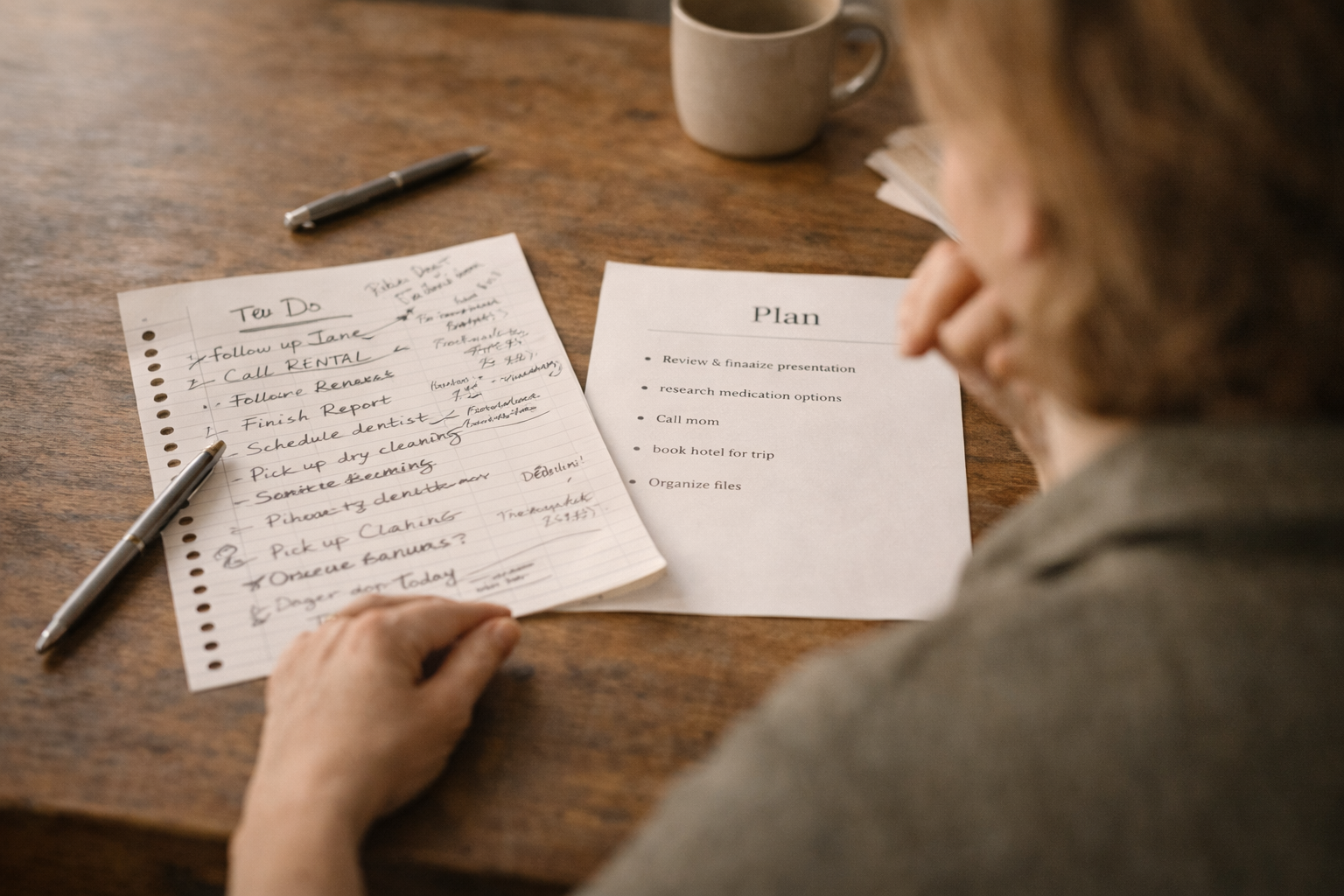
A cluttered to-do list next to a clean plan in warm light.
When families don’t follow through, it’s rarely because they don’t care.
It’s usually because one of these predictable failure points shows up:
1) No plan → it never starts.
The idea is meaningful, but it stays vague. Vague things get postponed.
2) No frame → it never finishes.
Without scope, every conversation feels like it should cover everything. That weight makes it easy to avoid.
3) No stewardship → it feels awkward or risky.
If someone worries about being recorded, judged, or misrepresented, hesitation is natural. Respect and clarity remove that friction.
If you’ve ever heard, “My life is boring,” or “I don’t have much to say,” you’re seeing this dynamic in action. You may also like: The Reluctant Storyteller: How to Unlock the ‘Boring’ Life.
The good news is that these failure points aren’t personal. They’re structural. And structure—done thoughtfully—makes this work easier, not harder.
The simplest next step

A workbook on a table beside a pen and mug in soft light.
If you’re reading this, there’s likely someone whose story matters to you.
And you probably don’t want a folder of audio files that no one knows how to navigate.
You want something finished. Something meaningful. Something your family can return to—not once, but for years.
That’s what the OHP Starter Kit is designed to support.
It helps you move forward with:
clarity about what matters most
a structure that makes the story coherent and finishable
a respectful approach that builds trust
a plan that leads to a keepsake your family will actually revisit
If you’re ready to move from “we should do this someday” to something real and finished, start here:
FAQs
What if they’re private or camera-shy?
That’s more common than you think. Privacy usually means someone wants control, clarity, and dignity. A respectful approach honors boundaries and makes participation feel safe rather than performative. When people know the purpose and feel in control, they tend to relax—and the stories come more naturally.
What if we don’t have a “dramatic” story?
Most families don’t—and that’s the point. Oral history isn’t about drama. It’s about meaning: how someone saw the world, what they endured, what they valued, what they hoped for, and what everyday life looked like. Those “ordinary” details often become the most precious later.
What if I’m afraid of doing it wrong?
That fear is a good sign—it means you care about doing this respectfully. The solution isn’t perfection; it’s a framework. When you have a thoughtful plan, boundaries, and clear purpose, the process becomes lighter and more natural. You don’t have to wing it.
Closing
At some point, preserving stories becomes less about whether and more about when.
The “right time” rarely announces itself. But a thoughtful first step can be enough to begin.
If you want the clearest next step toward a finished keepsake your family will value for generations, the OHP Starter Kit is built for exactly that.

Start Preserving Your Stories Today
Invest in the Oral History Starter Kit—prompts, planning tools, and a simple step-by-step process to help you record meaningful stories with confidence.
A guided toolkit that helps you plan, record, and preserve an interview—without the overwhelm.
Ask better questions with prompts that invite real stories
Stay organized with a simple session plan (prep → record → follow-up)
Capture clean audio/video with practical setup guidance
Handle sensitive moments with respectful consent and comfort tips
Preserve it properly so files stay accessible for the long haul
What's Included
This digital toolkit, developed from years of professional practice, provides the essential tools and templates to start your oral history project today:
Project Planning & Scoping Workbook: Define your goals and create a clear roadmap.
Customizable Informed Consent Form: The essential ethical document for any project.
The Essential Interview Checklist: A step-by-step guide for before, during, and after your interview.
Guide to Affordable & Effective Recording Equipment: Our top picks for any budget.
Oral History Transcription Template: A professional template to accurately transcribe interviews.
PLUS: Bonus Documents & Community Support (A $125+ Value!)
Here is 🎁 The Interviewer's Success Pack: Your free bonus guides (a $125 value). These added resources ensure you are fully prepared for every interview and have ongoing access to support.
The Interview Success Planner: Essential pre-interview worksheet for background research and preparation.
The Storykeeper's Log: Critical post-interview field notes template to capture immediate insights.
Private Facebook Group Invitation: Connect with fellow practitioners for tips, advice, and support.
Included free with your Starter Kit purchase.
If you want a simple, ethical way to capture meaningful stories—start here.
What you get: A complete digital Starter Kit—prompts, planning workbook, session checklist, consent form, and recording/transcription templates.
Timeframe: Start planning today and record your first interview this week.
Who it’s for: Anyone who wants to preserve meaningful family stories with a simple, ethical process—no experience required.
No experience needed • Ethical consent template included • Step-by-step guidance
One-time purchase. Instant access.
Site Menu
© 2025 The Oral History Practice, LLC. All rights reserved.
Instagram
Youtube
Facebook